
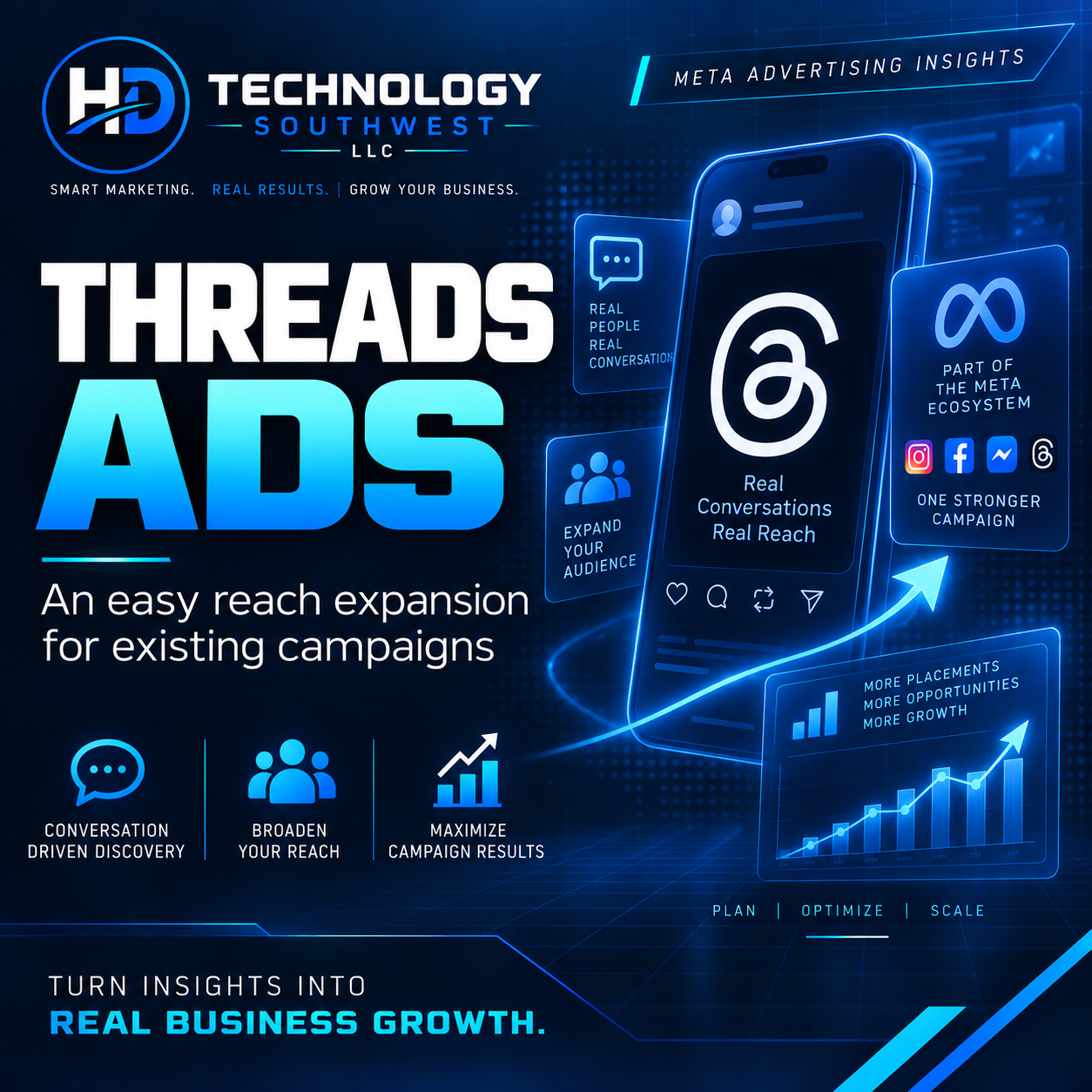
Small business owners have a reasonable reaction whenever another advertising placement appears: “Great, one more thing I have to learn.” Threads ads do not have to work that way.
Meta has been expanding advertising on Threads, and one of the practical advantages is that Threads can function as an additional placement within the broader Meta advertising system rather than a completely separate marketing universe. Meta has described Threads as an easy way for advertisers to extend the reach of existing campaigns through its automated placement system.
That makes the decision less about whether every company needs a “Threads strategy” and more about whether your campaign benefits from giving Meta another environment in which to find the right person at the right cost.
A new placement cannot fix a confusing offer or weak conversion path. Our free audit shows you where prospects may be dropping off before you add more traffic.
Request the Free AuditWhat makes Threads different?
Threads is built around conversation, commentary and discovery. The experience is more text-forward than Instagram and less centered on friends-and-family connections than traditional Facebook use. That changes the context in which an ad appears.
A polished promotional graphic can still work, but advertisers should pay attention to the surrounding environment. Ads that feel like useful observations, strong opinions, short insights or conversation starters can fit naturally into a feed where people are already reading and responding to ideas.
This does not mean every ad needs to look homemade. It means the message should respect the placement. The same principle already applies across Meta: an Instagram Reel, a Facebook Feed ad and a Story may be part of the same campaign, but they do not have to feel identical.
Why automated placements matter
Many advertisers still think of placements as a checklist they should manually control. Facebook Feed: yes. Instagram Feed: yes. Stories: maybe. Audience Network: no. Threads: unknown. That instinct comes from wanting to know exactly where every dollar goes.
The problem is that manual placement restrictions can remove inventory the algorithm might have used efficiently. If your objective is conversions and Meta can find a person likely to convert on Threads at a competitive cost, automatically allowing that placement may be useful. You can still evaluate placement-level performance afterward rather than assuming in advance that a newer surface is bad.
The key is to judge the complete outcome. Cheap impressions are not enough. A placement deserves budget when it contributes to qualified leads, appointments or sales.
Who should test Threads ads?
Businesses with educational, opinion-driven or expertise-based marketing may have an especially natural fit. Consultants, agencies, professional services, technology companies and business-to-business brands often have useful things to say beyond a promotion. Threads gives those messages another environment in which to circulate.
Local service companies can use it too, especially when the creative starts with a problem or useful observation rather than a coupon. “Three things Phoenix homeowners should check before replacing an AC system” is a more natural conversation entry point than a giant red “SALE” banner.
Ecommerce brands may use Threads as part of broader campaigns, particularly when Meta’s system can automatically adapt delivery across its inventory. But the business case should still be driven by actual performance rather than novelty.
Do you need Threads-specific creative?
Not necessarily on day one. If Threads is being added through automated placements, the fastest test may be to allow existing assets that adapt properly. But once you have enough data to justify continued investment, placement-aware creative becomes more interesting.
Consider short, direct copy. Use observations that invite agreement or curiosity. Build ad concepts around questions people already ask. Avoid trying to cram an entire brochure into the post. If the idea needs explanation, let the landing page do some of the work.
Use Threads to extend a campaign, not fragment it
One risk with every new platform is fragmentation. A small business can quickly end up with separate content calendars, different agencies, separate analytics and a dozen partially managed channels. Threads is more attractive when it strengthens an existing Meta campaign rather than creating another silo.
Keep the campaign goal consistent. If the goal is booked consultations, Threads traffic should feed the same measured conversion path. If the goal is qualified leads, apply the same definition of a qualified lead. If a Threads placement produces a lower cost per lead but much weaker contact quality, the business should know that.
What to measure
Start with the same funnel metrics you should use elsewhere: cost per qualified lead, landing-page conversion rate, contact rate, appointment rate and customer acquisition cost. Then use placement data as a diagnostic layer.
If Threads gets good engagement but poor conversions, the message may be interesting without being commercial enough. If it gets fewer clicks but strong downstream conversion, that may be perfectly acceptable. The objective is not to “win Threads.” The objective is to acquire customers efficiently.
Also watch whether the creative format is being adapted correctly. Text may crop differently, images can display in different ratios, and calls to action may feel more or less natural depending on the placement. Check the preview rather than assuming the platform will make every asset beautiful automatically.
We can review where your traffic is going, how the offer is presented and whether adding placements makes sense for your budget and sales process.
Book a Free ConsultationThreads and the bigger Meta strategy
The more important story is not Threads by itself. It is Meta’s effort to give advertisers a connected pool of inventory across Facebook, Instagram, Messenger, Threads and other placements, with AI deciding where opportunities are strongest.
For advertisers, that means campaign architecture may continue getting simpler while creative and measurement get more important. Rather than building a separate campaign for every surface, the platform wants businesses to provide a goal, useful assets and conversion data, then let the delivery system allocate impressions dynamically.
That can work well for a small business if the tracking is trustworthy. If tracking is weak, automation can optimize toward the wrong signals faster. The better your conversion data, the more useful broad automated delivery becomes.
What I would do with a local-business budget
I would not carve out a large standalone Threads budget simply because the placement is new. I would start by allowing it inside an appropriately structured campaign, make sure the creative renders well and compare downstream results.
If the placement begins contributing qualified leads at an acceptable cost, I would then test some creative designed specifically for a conversation-driven environment. If it does not contribute meaningful business results, I would not keep it simply for reach.
This measured approach keeps the business focused on outcomes instead of platform hype.
Organic Threads activity can help your paid strategy too
Even if your immediate goal is advertising, watching organic conversations can be useful research. Pay attention to the language people use when they describe problems in your industry, the questions that get replies and the opinions that trigger discussion. Those patterns can become ad hooks and landing-page copy.
You do not need to chase every trend. The value is listening for customer language. A sentence that appears repeatedly in real conversations is often more useful than a clever slogan written in a conference room.
How to avoid turning Threads into another content burden
Repurpose intelligently. A short insight from a blog article can become a Threads post. A customer FAQ can become a short conversation starter. A strong Meta ad hook can be rewritten as an organic observation. Build from the same core ideas rather than inventing a completely separate content machine.
For a small team, consistency beats volume. One or two useful posts that sound like a real business can do more for credibility than a stream of generic AI-generated updates.
A simple Threads test plan
Give the placement enough time and budget to produce meaningful data. Start with your existing conversion campaign and automated placements. Confirm that the creative renders correctly on Threads. After the first learning period, compare cost and quality of outcomes by placement without making decisions from a handful of clicks.
If Threads shows promise, add one or two conversation-friendly creative concepts. Use short hooks, direct observations and customer questions. Keep the destination and tracking the same so you can compare the effect of the placement and creative rather than changing the entire funnel at once.
What not to do
Do not move budget simply because Threads has cheaper CPMs. Cheap reach is only useful when it contributes to business outcomes. Do not create a separate brand voice that feels disconnected from the rest of your marketing. And do not assume that because Threads is newer, every competitor has ignored it. Evaluate the opportunity based on your own numbers.
Most importantly, do not use another placement as an excuse to postpone fixing a weak offer. Distribution is not the same thing as demand.
The bottom line
Threads ads are worth understanding because they represent another way Meta can expand campaign reach without requiring advertisers to build an entirely new advertising operation. For many businesses, the smartest first step is not a standalone Threads campaign. It is allowing the placement inside a broader strategy, then letting the data tell you whether it deserves more attention.
Before adding more traffic, make sure your website and follow-up path are ready. You can start with our free website and lead-generation audit. If you want help deciding where Threads fits into your current Meta advertising plan, book a free consultation with HD Technology Southwest.
Further reading: Meta explains the expansion of Threads advertising in Ads on Threads: One Year In.
Comments
No comments yet.
Leave a reply