
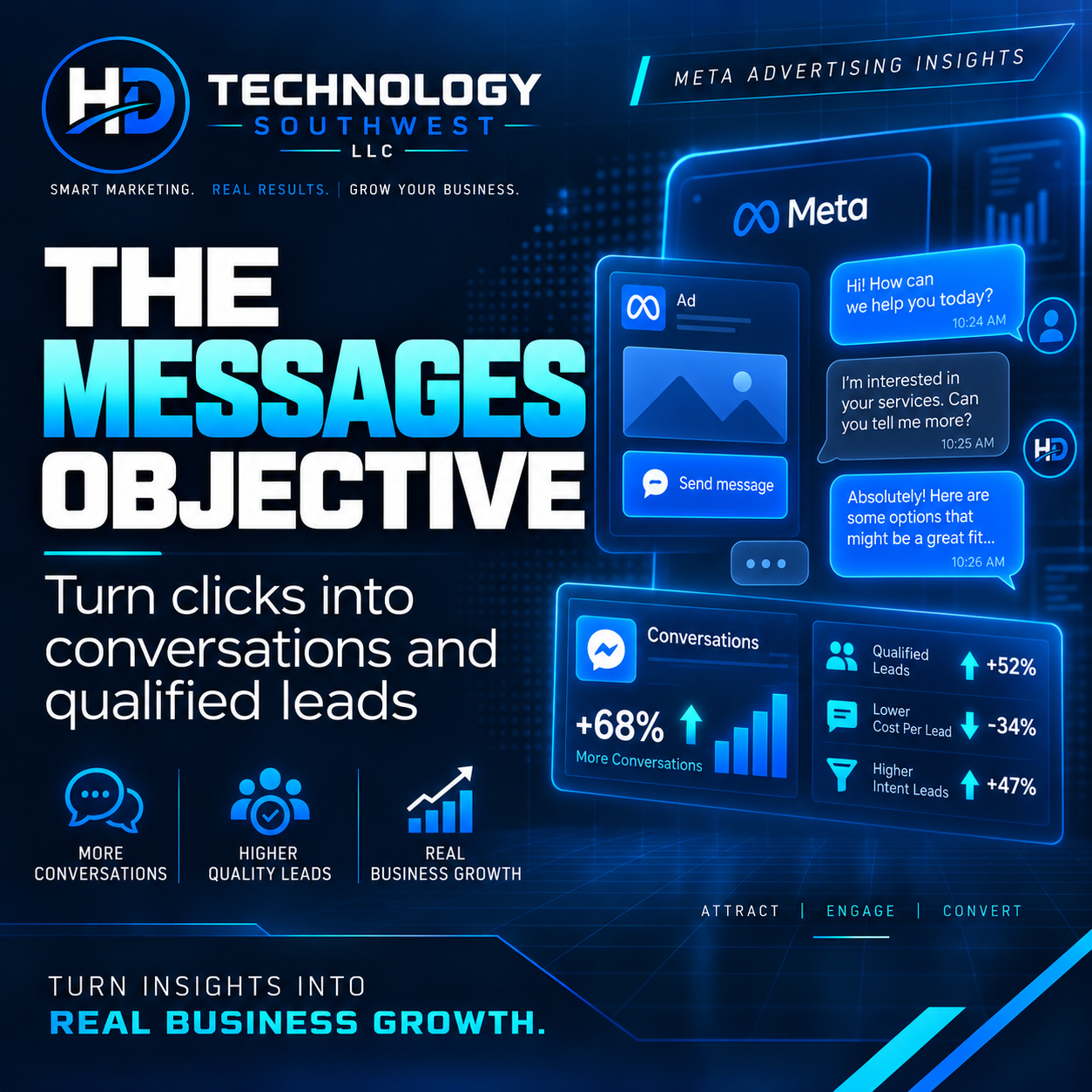
Most lead-generation advertising asks a prospect to do something that feels like paperwork: click an ad, open a page, fill out a form, submit it and wait. That process can work extremely well, but it is not always how people naturally want to communicate with a business.
Sometimes they just want to ask a question.
Meta’s message-focused advertising options are built around that behavior. Meta has highlighted the Messages objective and click-to-message experiences as ways businesses can generate leads, answer questions and move people toward transactions through conversation. For businesses where sales already happen through phone calls, text messages or direct messages, this can be a very natural extension of the existing sales process.
But message ads introduce a new operational truth: the campaign is only as good as the conversation that happens after the click.
Our free audit looks at the customer path from first impression through contact—including whether your website makes it easy for prospects to take the next step.
Get the Free AuditWhy messaging can be powerful
A message has lower psychological friction than many traditional forms. A prospect can ask, “Do you service my area?” “How much does this usually cost?” “Do you have appointments this week?” or “Can someone explain the difference between these options?” Those questions signal intent while letting the buyer stay in a familiar conversation environment.
That is especially useful when the service requires some explanation. Home improvement, medical and cosmetic services, professional services, automotive, education and many higher-consideration purchases often involve questions before a buyer is willing to schedule.
A well-designed message campaign can capture that hesitation and turn it into dialogue instead of losing the visitor.
Conversation quality matters more than message volume
It is easy to celebrate a low cost per message. But a cheap conversation is not necessarily a good lead. Some people may click casually. Others may ask questions outside your service area. Some may be looking for employment, customer support or something your business does not offer.
The important metric is not merely conversations started. Track how many become qualified opportunities. Then track appointments, estimates and sales. If a campaign generates 100 conversations but only five real prospects, the headline cost-per-message number can hide a weak campaign.
This is where simple qualification helps. Your opening flow can ask one or two useful questions: location, service needed, timing, homeowner status, budget range or another variable that genuinely changes whether the lead is a fit. Keep it conversational. Do not turn Messenger into a twenty-question form.
The response-time problem
Message advertising can expose a business’s follow-up weakness immediately. A prospect starts a chat because they expect interaction. If nobody responds until the next morning, the experience feels broken.
That means campaign planning has to include staffing. Who owns incoming conversations? What happens during business hours? What happens after hours? What questions can be answered automatically? When should automation hand the conversation to a human?
You do not need a giant call center. You need a clear process. A small business with one responsible person and a defined response standard can outperform a larger company where nobody knows who is supposed to answer.
Use automation for speed, not deception
Automated greetings, FAQs and qualification questions can be helpful because they give the prospect immediate direction. They can collect basic information and answer common questions while a human is unavailable.
The mistake is pretending an automated system is a person when it is not, or forcing somebody through a rigid bot maze when they are trying to ask a simple question. The best automation removes waiting and repetitive work. It should make it easier to reach a human when judgment is needed.
A good flow might acknowledge the inquiry immediately, ask what service the person needs, confirm the service area, collect preferred contact information and offer a booking link. Then a human can take over with context instead of starting from zero.
Message ads need a sales script—but not a robotic one
The people answering messages should have a framework. That does not mean copying and pasting a long script into every conversation. It means knowing the objective of the first exchange.
Start by answering the prospect’s question. Then learn enough to determine whether there is a fit. Confirm the problem, location and urgency. If the person is qualified, make the next step simple: call, appointment, estimate or consultation.
Do not drown a new lead in paragraphs about your company. The prospect started a conversation because they want help with something. Keep the focus there.
When a website is still better
Messaging is not automatically superior to a website form. Some offers need more detail, legal disclosures, pricing context, galleries, case studies or other information before a prospect is ready to talk. Some businesses need structured data that is easier to collect through a form.
The smartest setup may offer both. High-intent visitors can start a conversation immediately. Research-oriented visitors can read the landing page, compare options and then schedule when ready. The campaign can route different creative angles to the path that makes the most sense.
We can look at whether your campaign should drive calls, forms, bookings, messages—or a combination—and how those leads should be handled once they arrive.
Book a Free ConsultationTracking message leads all the way to revenue
This is where many businesses stop too early. They track messages started and maybe mark conversations as leads. The real value comes from connecting the conversation to the eventual sale.
Create a simple lead-status system. New inquiry. Contacted. Qualified. Appointment booked. Appointment completed. Proposal or estimate. Won. Lost. Even if the process begins in a direct message, the later stages should be recorded somewhere the business can review.
Once you know which message campaigns and creative angles produce actual customers, budget decisions become much easier. Without that connection, the platform may optimize for people who like chatting rather than people who buy.
Creative ideas for message campaigns
The strongest message ads often give somebody a reason to ask. Try ads that invite a specific question: “Not sure which option fits your home?” “Want to know what this typically costs?” “Send us your ZIP code and we’ll tell you whether we service your area.” “Tell us what you’re trying to accomplish and we’ll point you in the right direction.”
That is stronger than a generic “Message us today” because it gives the prospect a conversational starting point.
Use real photos, demonstrations, customer questions, short videos and simple educational graphics. The ad should create enough trust for someone to raise their hand.
Build a short conversation map before launch
Write down the five most common first questions prospects ask and the three pieces of information your team needs before recommending the next step. That becomes the backbone of the message flow. Keep it short enough that a person can move through it naturally.
Then define handoff triggers. A request for pricing may go to sales. A technical question may go to a specialist. A complaint should go to a human immediately. A booking request should move straight to scheduling. Mapping those routes before launch prevents the “who is supposed to answer this?” problem after leads start arriving.
Use the conversations as market research
Message campaigns produce something most dashboards cannot: the actual words prospects use. Review them. Which question appears before somebody books? Which objection keeps stopping the sale? Are people confused about price, service area, timing or what is included?
Those conversations should influence future ads and landing pages. If ten people ask the same question, answer it earlier in the journey. If qualified prospects repeatedly mention the same concern, build creative around it. The message inbox can become a direct research channel for improving the entire campaign.
A practical first-week message campaign checklist
Before launch, test the ad yourself from a phone. Click through, send a message and experience the exact flow a prospect sees. Verify the greeting, automation, notifications and handoff. Make sure somebody receives an alert. Confirm the booking link works. Check what happens after hours.
During the first week, review conversations daily. Categorize each one as qualified, unqualified, support-related or unclear. Note response time and whether the conversation reached the intended next step. This will tell you much more than the raw number of chats.
How to scale without overwhelming the team
If conversations increase faster than staff can handle them, raising the budget can actually make performance worse. Scale only when the response process can keep up. Automation can help with first response and basic qualification, but there should still be enough human capacity for serious prospects.
A good marketing system respects operations. The goal is not the maximum possible number of leads. It is the number of good opportunities the business can respond to and convert well.
The bottom line
The Messages objective is interesting because it shortens the distance between advertising and sales conversation. For the right business, that can remove friction and produce higher-intent interactions. But it also exposes weaknesses in response time, qualification and follow-up.
Do not launch message ads until you know who will answer and what the next step should be. Then measure the campaign based on qualified opportunities and sales, not just chat volume.
If you want to see whether your current website and lead journey are creating unnecessary friction, request our free website and lead-generation audit. If you want to build a message-to-sale process around Meta advertising, schedule a free consultation.
Further reading: Meta describes message-focused advertising in Introducing the Messages Objective for Facebook Ads.
Comments
No comments yet.
Leave a reply