
Advertising has always had an uncomfortable gap between marketing and sales. A campaign generates interest, a person clicks or sends a message, and then the business has to do something with that opportunity. That handoff is where a surprising amount of money disappears.
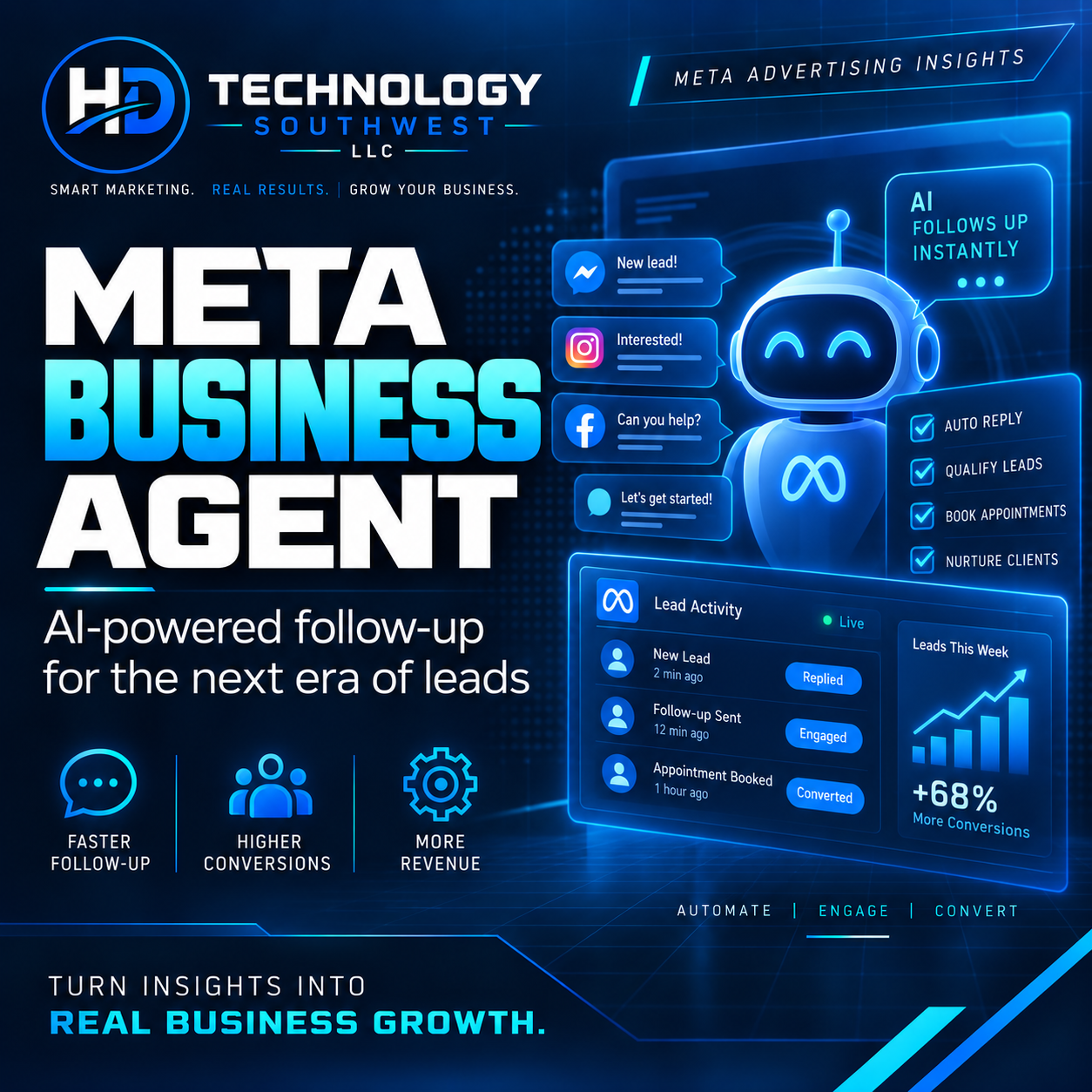
Meta Business Agent points directly at that gap. In its 2026 Conversations announcements, Meta introduced Business Agent as an AI system intended to help businesses show up for customers across moments of interaction. The broader direction is clear: Meta does not only want AI to decide which ad to show. It wants AI to help businesses handle the conversations that follow.
For a small business, that can sound either exciting or terrifying. Used well, AI can reduce response times and make sure routine questions do not sit unanswered. Used badly, it can create awkward automated conversations that damage trust.
The right goal is not to replace the human sales process. It is to remove dead time and repetitive work so humans can spend more time where judgment and relationship actually matter.
Our free website and lead-generation audit reviews how easily a prospect can understand your offer, contact you and take the next step.
Request the Free AuditThe lead-response problem AI can actually solve
Speed matters because buyer attention is fragile. Someone sees an ad, has a moment of motivation and reaches out. Ten minutes later they may be back at work. An hour later they may have contacted two competitors. By the next day, the urgency may be gone.
Most small businesses understand this but still struggle operationally. The owner is on a job. The receptionist is helping someone else. The salesperson is driving. An inquiry arrives at 8:30 p.m. Nobody is deliberately ignoring the lead; the business simply cannot have a person watching every channel every minute.
AI-assisted response systems can help by acknowledging the inquiry immediately, answering common questions, collecting basic information and offering the next step. That is real operational value.
What should be automated first
Start with repetitive, low-risk interactions. Service-area questions. Hours. Basic appointment availability. Common preparation instructions. The information a business asks every new lead. A link to scheduling. A request for a photo or model number when that helps diagnose the request.
These interactions are predictable and can be designed carefully. They save time without asking the AI to make a complicated judgment.
Next, automate routing. If someone wants sales, send them toward sales. If they are an existing customer with a support issue, route them differently. If the inquiry is outside the service area, say so politely rather than wasting both sides’ time.
Only after those basics work should a business consider more sophisticated automated qualification and nurturing.
Where humans still matter most
High-stakes questions need judgment. Pricing exceptions, sensitive customer complaints, medical or legal issues, unusual project requirements and negotiation are not places to blindly trust automation.
Humans also matter when emotion enters the conversation. A homeowner whose air conditioning has failed in extreme heat is not just asking for a service slot. A business owner worried about a major investment may need reassurance. A prospect comparing companies may be looking for evidence that somebody actually understands their situation.
AI can prepare the context. A person can create trust.
AI follow-up needs boundaries
Every automated system should have rules for when it stops and hands off. If the prospect asks a question the system does not understand, escalation should be easy. If somebody is clearly ready to buy, do not keep them trapped in a bot sequence. If a customer becomes upset, let a person take over.
The business should also decide what the AI is allowed to promise. It should not invent discounts, appointment times, warranties, guarantees or technical claims. The system needs accurate source information and clear limits.
Review conversations regularly. Automation is not “set it and forget it.” The transcript shows where customers get confused, what questions appear repeatedly and where the AI needs better instructions.
How AI can improve lead qualification
Qualification does not have to feel like an interrogation. A few well-chosen questions can help determine intent and prepare the salesperson.
A home-service business might ask for ZIP code, service needed and desired timeframe. A marketing company might ask about the business type, primary growth goal and approximate ad budget. A medical practice might ask which service the person is interested in and preferred appointment window while staying within appropriate privacy and compliance boundaries.
The AI can summarize those answers before a human joins. Instead of opening a conversation with “How can I help you?” the salesperson can start with context: “I see you’re looking for a replacement system in 85014 and hoping to get it handled this month.” That feels faster and more competent.
Automation can nurture the leads who are not ready today
Not every good prospect is ready to book immediately. Some are researching. Some need to talk to a spouse or partner. Some are waiting for a budget cycle. The traditional approach is to hope they remember you later.
AI-assisted follow-up can make structured nurturing easier. Send the promised guide. Follow up after a reasonable period. Answer the next question. Remind the person how to schedule. The objective is not to bombard them. It is to keep the conversation alive when there is legitimate interest.
We can map the advertising, lead capture, booking and follow-up as one system—then decide where automation genuinely helps.
Book a Free ConsultationMeasurement becomes even more important
If AI is helping manage conversations, the business needs to know whether those conversations are producing better outcomes. Track response time, qualification rate, appointment rate, show rate, close rate and revenue.
Do not celebrate a bot because it handled 1,000 messages. Celebrate it if prospects get answers faster, salespeople receive better context, fewer leads disappear and customer acquisition becomes more efficient.
Also measure where automation hurts. If prospects abandon a conversation at the same question repeatedly, fix it. If booked appointments are lower quality, change the qualification logic. If customers keep asking for a human, make that path easier.
What this means for Meta advertising
The most interesting part of Business Agent is the possibility of a more connected advertising-to-conversation loop. Meta already has enormous information about how people interact with ads on its platforms. As business messaging and AI assistance become more integrated, the distance between seeing an ad, asking a question and taking a sales action can shrink.
That increases the importance of the entire system. An advertiser can no longer think only about the ad creative. The ad, conversation, qualification, booking and sales process become pieces of one measurable journey.
This fits the direction Meta is already taking with Advantage+ and other AI-driven tools: automate repetitive decisions, use more conversion data and optimize toward outcomes. The businesses that benefit most will be the ones with clean processes and clear definitions of success.
How a small business should prepare now
Document the questions customers ask most. Define what makes a lead qualified. Write down your service boundaries, hours, pricing rules and scheduling process. Decide who owns the lead when automation hands off. Make sure you have a way to track what happened after the initial conversation.
None of that requires sophisticated AI. It is basic operational clarity. Once it exists, automation becomes much safer and more useful.
If your current process is chaotic, adding AI will often automate the chaos. Fix the workflow first.
Create a knowledge base before you create an AI salesperson
AI follow-up works best when the business has one reliable source of truth. Build a simple internal knowledge base with service descriptions, service areas, hours, common questions, approved pricing language, financing information, booking rules and escalation instructions. Keep it current.
Without that foundation, an automated agent is forced to guess or pull from inconsistent information. With it, the system can answer routine questions confidently and know when the situation falls outside its authority.
Keep a human review loop
Schedule regular reviews of automated conversations. Look for wrong answers, awkward tone, repeated customer confusion and missed opportunities. Update the instructions and knowledge base based on what actually happens.
This is similar to coaching a salesperson. You would not hire someone, give them a script and never listen to a call again. AI systems also need feedback. The advantage is that the transcripts make patterns easier to spot.
A sensible rollout path for AI follow-up
Phase one is observation: document the questions customers already ask and how your best salesperson answers them. Phase two is assistance: use AI for suggested replies, summaries and internal notes while a human still controls the conversation. Phase three is limited automation: allow the system to handle a small set of approved questions and actions. Phase four is expansion, but only after the earlier stages are accurate and measurable.
This gradual approach lets the business earn confidence instead of giving an automated system too much authority on day one.
Think beyond the first response
The larger opportunity is continuity. A good system can remember that a prospect requested information, send the promised resource, remind them about an appointment and give the salesperson context when the conversation resumes. That is more valuable than a chatbot that only says hello.
As AI becomes more connected to advertising and messaging, continuity will likely become one of the major competitive advantages. Small businesses that organize their customer information now will be better positioned to benefit.
The bottom line
Meta Business Agent is part of a larger shift from AI that merely optimizes ad delivery toward AI that participates in the customer journey. For small businesses, the most valuable use case is straightforward: respond faster, answer routine questions, gather context and make it easier for a qualified prospect to reach the next step.
The human part still matters. Trust, judgment, negotiation and real problem-solving are not going away. The opportunity is to let automation handle the repetitive work around those moments.
If you want to identify where your current site and lead flow are losing opportunities, start with the free HD Technology Southwest audit. If you want to talk about how AI follow-up, Meta advertising and your sales process could work together, schedule a free consultation here.
Further reading: Meta introduced Business Agent in its Conversations 2026 announcement.
Comments
No comments yet.
Leave a reply