
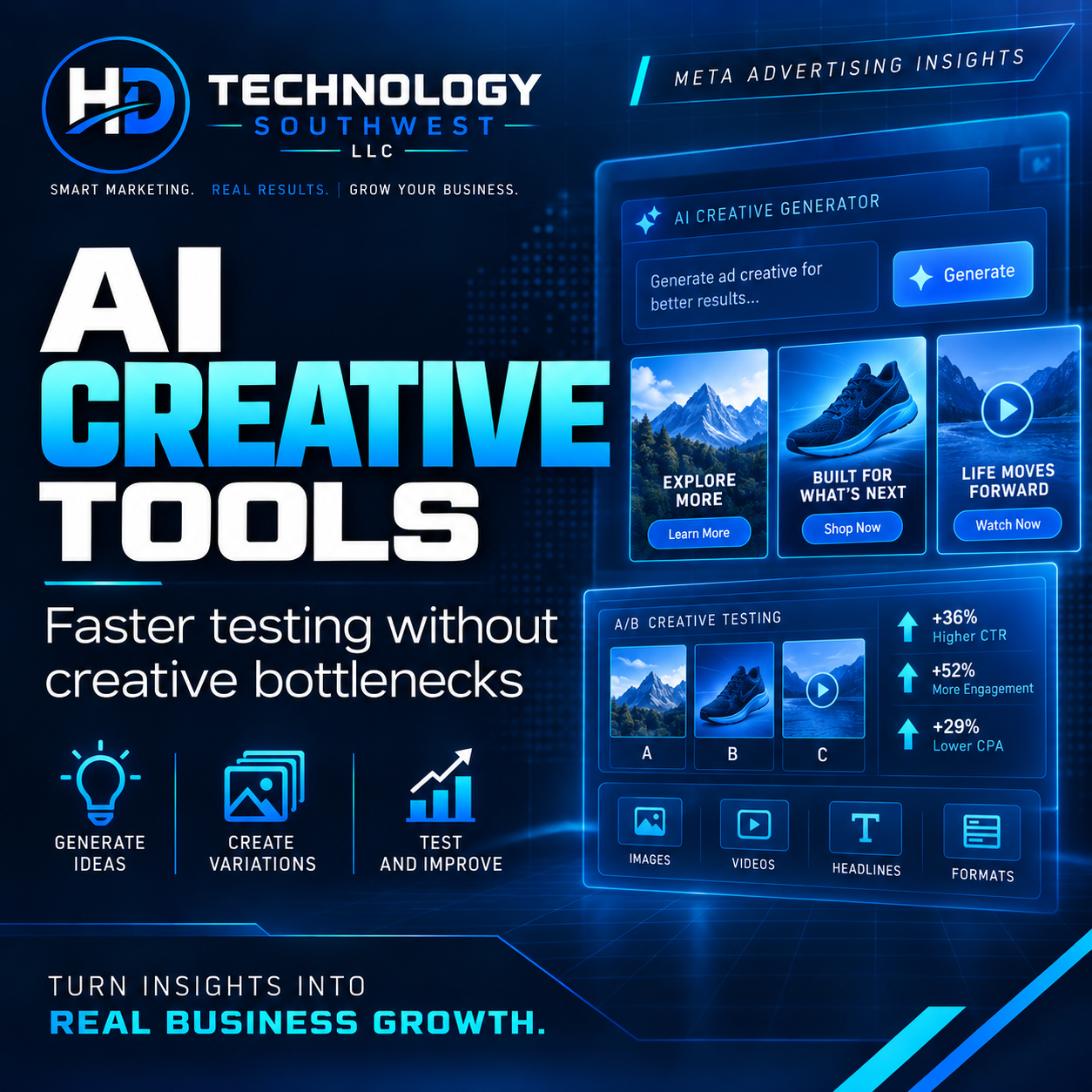
For years, creative production has been one of the biggest bottlenecks in Meta advertising. A campaign might have a good offer and a reasonable budget, but the business only has two images, one video and a handful of headlines. Those assets run for weeks, performance eventually softens, and everybody starts blaming the audience.
AI creative tools are changing that workflow. Meta has been expanding generative features designed to help advertisers produce and adapt images, text and other creative variations more quickly. In 2026, the practical question is no longer whether AI will touch advertising creative. It already does. The question is how to use that speed without flooding your account with generic ads that all look and sound the same.
The best use of AI is not “make my marketing for me.” It is “help me explore, adapt and test more efficiently while I stay in control of the idea.” That distinction matters.
Our free website and lead-generation audit identifies friction in your website, message and conversion path before you spend more money promoting it.
Get the Free AuditCreative is becoming the new targeting
As Meta’s delivery systems become more automated, advertisers are giving the platform broader audiences and more freedom to find likely converters. That makes the actual ad more important. Your creative tells a person, in a fraction of a second, whether the message is relevant to them.
A plumbing company can show a homeowner standing beside a leaking water heater with copy about same-day replacement. A med spa can speak to people frustrated by a specific cosmetic concern. A business-to-business service can open with the exact operational problem its buyers complain about. None of those examples requires a complicated interest stack. The message itself helps qualify the audience.
This is why AI creative tools are potentially useful. They can make it easier to develop multiple executions of a strong idea: different crops, backgrounds, formats, hooks and text treatments. But the central idea still has to come from understanding the customer.
The dangerous version of “more creative”
There is a bad version of creative volume: twenty nearly identical ads produced because the software can generate them. More files do not automatically mean more learning. If every variation uses the same claim, same concept and same emotional angle, the campaign is not testing much at all.
Useful variation changes something meaningful. One ad might focus on avoiding a costly problem. Another might focus on convenience. Another might use proof. Another might explain the process. Another might address price hesitation. Those are different reasons to respond, and the results can teach you something about the market.
AI is excellent at helping execute those variations once the strategy is clear. It is much weaker when the prompt is simply “make me a Facebook ad that converts.” That prompt gives the model no real customer insight, no distinctive positioning and no understanding of your sales process. The result often sounds polished but interchangeable.
A practical creative testing system
Start with angles before assets. Write down five or six different reasons a prospect might care. For a home-service company, those could be urgency, reliability, financing, warranty, speed and trust. For a professional service, the angles might be lost revenue, wasted time, risk, expertise, simplicity and measurable outcomes.
Next, create multiple hooks for each angle. A hook is the first idea someone processes. It can be the first line of copy, the first three seconds of a video, the headline on a graphic or the visual itself. Strong hooks are specific. “Grow your business” is broad. “Getting leads but struggling to get them on the phone?” immediately speaks to a recognizable problem.
Then use AI to help adapt. Turn a winning concept into square, vertical and story-friendly layouts. Test a clean graphic against a photo-led version. Explore headline variations without rewriting the entire ad manually. Use generative tools to brainstorm scenes or backgrounds when you do not have a full photo library.
What AI should not be allowed to invent
Do not let generative tools create claims you cannot prove. That includes fake reviews, invented customer outcomes, fictional awards, fabricated before-and-after results or performance statistics that did not happen. The technology can produce convincing-looking numbers and testimonials, which is exactly why a human needs to control what becomes public.
The same rule applies to product and service details. If the model adds a guarantee, financing term, turnaround time or feature that your business does not actually offer, the ad may look great and still create a customer-service problem.
For regulated industries—health, finance, housing, employment and other sensitive areas—creative also needs a policy review. Faster production does not remove advertising rules.
Use AI to multiply winners, not hide weak strategy
A useful workflow is to find a message that earns attention, then use AI to expand it. Suppose a local contractor discovers that ads explaining “three signs your AC is near the end of its life” outperform generic discount ads. That idea can become a carousel, a short video, a checklist graphic, a homeowner story, a landing-page section and a follow-up email. The concept becomes a content system.
That is very different from asking AI for another random ad every few days. When a winning message is identified, consistent expansion can reinforce it across the entire customer journey.
Creative testing and the landing page have to agree
One of the easiest ways to waste a strong ad is to send it to a page that feels unrelated. If the ad promises a specific service, the landing page should immediately continue that conversation. If the ad speaks to a certain industry, the page should look like it was built for that industry. If the ad offers a free audit, the visitor should not have to hunt through a general homepage to find it.
This message match is especially important as creative testing gets faster. A new ad angle may need a corresponding landing-page section or even a dedicated page. Otherwise you can get high click-through rates and weak conversion rates because the promise changes after the click.
We can look at the ad, landing page, tracking and follow-up together instead of treating each part as a separate project.
Book a Free ConsultationHow much creative is enough?
There is no magic number. A business spending a few hundred dollars per month does not need the same production volume as an ecommerce brand spending thousands per day. The right amount is enough to give the campaign real alternatives without spreading the budget so thin that nothing gets meaningful delivery.
For many local businesses, a small set of clearly different concepts is more useful than dozens of micro-variations. Watch which hooks attract attention, which ads generate qualified responses and which messages survive beyond the first burst of novelty.
When performance fades, diagnose before replacing everything. Is the creative tired? Is the offer weak? Did lead quality change? Did the landing page slow down? Did the sales team stop following up quickly? Creative is one part of a system.
The best role for AI in your creative process
Think of AI as a fast production partner. It can help brainstorm, resize, rewrite, visualize and organize. It can lower the cost of experimentation and help a small company produce a level of variation that used to require a larger creative team.
But your brand still needs a point of view. Somebody has to know what the customer fears, what they want, what makes the company credible and which promise is worth making. When that thinking comes first, AI can make the execution dramatically faster.
Build a creative library instead of starting from zero every week
A disciplined advertiser keeps the pieces that work. Save winning hooks, testimonials, objections, customer questions, visual styles, calls to action and video openings. Label them by theme. Over time, you build a creative library that AI can help recombine and adapt without losing the brand’s voice.
This is especially valuable for a small business because the same material can be reused across ads, social posts, landing pages, email follow-up and sales materials. One strong customer question can become a Reel, a graphic, a blog section and a salesperson talking point. AI makes that repurposing faster, but the underlying insight remains yours.
What to review before an AI-generated ad goes live
Check the words first. Are every claim and price accurate? Does the offer match the landing page? Check the image next. Has the tool changed the product, location or people in a misleading way? Then check the mobile preview. Can the headline still be read at phone size? Is the main idea obvious without zooming in?
Finally, read the ad out loud. If it sounds like a generic marketing template, rewrite it. Your customer should recognize the problem immediately and understand why your company is relevant. Polished is useful. Specific is better.
A 30-day AI creative test for a small business
Week one, establish the baseline. Keep your current best ad running and document the numbers that matter: qualified leads, conversion rate and cost per opportunity. Week two, introduce two genuinely different concepts produced with AI assistance. Do not change everything else at the same time. Week three, take the strongest concept and produce two or three format variations for Feed, Stories and Reels. Week four, compare not only clicks but downstream lead quality.
The point of a structured test is learning. If a new concept wins, you know why you are scaling it. If it loses, you still learned something about the market. Random creative churn produces activity without much knowledge.
Keep the brand recognizable across variations
Use a consistent visual system: the same core colors, logo treatment, typography, tone and offer language. AI can change backgrounds and compositions while the brand remains familiar. That consistency matters when a prospect sees several ads over time before finally responding.
Variation should make the campaign feel alive, not make the business look like five unrelated companies.
The bottom line
AI creative tools are one of the most useful developments in Meta advertising because they attack a real constraint: producing enough good creative to keep learning. The winning businesses will not necessarily be the ones generating the most assets. They will be the ones using AI to test the most meaningful ideas while protecting brand consistency and factual accuracy.
If your ads are sending people to a site that is not converting, request the free HD Technology Southwest website and lead-generation audit. If you want help building a repeatable creative-testing and conversion system, schedule a free consultation.
Further reading: Meta has continued expanding AI-powered creative capabilities for advertisers through its 2026 advertising and creative announcements.
Comments
No comments yet.
Leave a reply